Dermaplaning Treatment in Doncaster
The skin’s surface is in a constant state of renewal — old skin cells are shed and replaced by new ones approximately every 28 days. However, this shedding process is not always as complete as it should be, and a layer of partially shed dead cells, trapped sebum and environmental debris accumulates on the skin surface over time. This accumulation is one of the most significant contributors to a dull, flat and uneven complexion — because light reflects off a smooth, clear surface far more effectively than off one that is rough and covered in microscopic debris.
Additionally, the fine vellus hair that covers most of the face — the “peach fuzz” that is barely visible in most lighting but becomes apparent in natural light or at close range — traps this debris in its fibres, contributing further to a muted and lacklustre skin appearance. Furthermore, vellus hair creates an uneven surface beneath makeup that prevents it from sitting flush against the skin, causing it to look patchy, uneven or cakey regardless of how carefully it is applied.
Dermaplaning addresses both issues simultaneously. The surgical-grade scalpel blade, held at a precisely calibrated angle against the skin by a trained therapist, removes both the vellus hair and the dead cell layer in a single pass — leaving the skin surface completely smooth, even and reflective. The immediate result is a noticeably brighter, more radiant complexion that looks visibly more alive and even, and a makeup-ready surface that allows foundation and other products to blend flawlessly and sit on the skin exactly as they are designed to.
Our Doncaster clinic is on Thorne Road with on-site parking, and we welcome patients from across South Yorkshire including Rotherham, Wakefield, Sheffield, Leeds and Barnsley.
What Is Dermaplaning and How Does It Work?
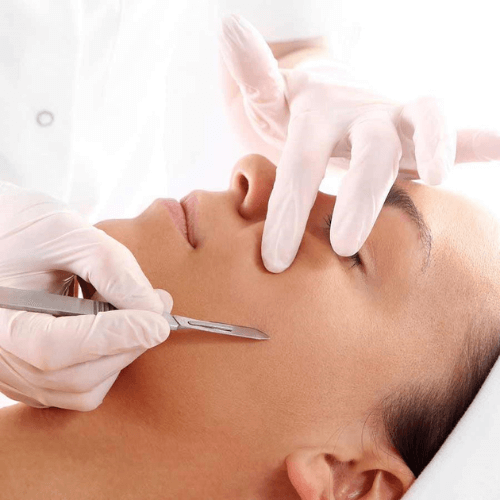
Dermaplaning is a manual exfoliation technique that uses a sterile, surgical-grade scalpel blade — specifically a No. 10 or similar blade held at a 45-degree angle to the skin surface — to physically remove the outermost layer of the epidermis alongside the vellus hair.
The blade is drawn across the skin in short, precise, feathering strokes by a trained therapist, systematically covering the full face except for the eyebrows and immediately around the eyes. Each stroke removes a thin layer of keratinised dead skin cells and the vellus hair from that section of skin. Consequently, by the end of the treatment the entire face has been exfoliated to its freshest, most even surface layer.
The mechanism is purely physical — no chemicals, no heat, no energy delivery. The scalpel blade simply shears the outermost surface cells and hair from the skin in a controlled and precise manner. Therefore dermaplaning is genuinely suitable for the most sensitive skin types, as it involves no chemical exfoliants and no thermal stimulus.
What happens to the skin after dermaplaning: With the dead cell layer removed, the skin’s natural ability to reflect light is immediately restored — producing the characteristic brightening and radiance effect. Additionally, with the barrier of dead cells removed, skincare products applied after treatment penetrate more deeply and distribute more evenly, enhancing their effectiveness. Furthermore, the smooth surface left by dermaplaning allows makeup to sit flush against the skin with an evenness and flawless finish that is difficult to achieve on un-dermaplaned skin.
The clinical evidence for mechanical exfoliation and its effects on skin surface quality and product penetration is supported by peer-reviewed dermatology research. British Journal of Dermatology — skin exfoliation and surface treatments.
How Is Dermaplaning Treatment Performed? Step by Step
Before treatment:
- Arrive with clean skin — no makeup or skincare products on the face
- Avoid retinoids and strong active skincare for 48 hours before your appointment
- Inform your therapist of any active skin conditions, recent procedures or sensitivities in the treatment area
During treatment:
- The face is thoroughly cleansed and prepared
- The therapist holds the sterile scalpel blade at a 45-degree angle to the skin surface and draws it across the face in short, controlled feathering strokes, working systematically across all areas of the face
- The treatment is comfortable and gentle — most patients find it deeply relaxing, describing the sensation as a light, scraping warmth across the skin
- The full treatment takes approximately 45 minutes
- No anaesthetic is required at any stage
After treatment:
- The skin will appear immediately brighter, smoother and more radiant
- Very mild, transient pinkness may be present for an hour or two — this resolves naturally and quickly
- Avoid applying retinoids, strong active skincare or physical exfoliants for 48 hours following treatment
- Apply broad-spectrum SPF before going outdoors — freshly dermaplaned skin is temporarily more sensitive to UV
- Results are immediate and last approximately three to four weeks as the skin’s natural renewal cycle progresses
- Monthly treatments maintain the smooth, radiant result consistently
The Purposes of Dermaplaning Treatment
1. Restoring Skin Radiance and Surface Smoothness by Removing the Dull Surface Layer
The primary purpose of dermaplaning is to restore the fresh, smooth and luminous skin surface that accumulation of dead cells, vellus hair and debris has been obscuring. By physically removing this layer, dermaplaning immediately reveals the newer, more reflective skin beneath — producing the characteristic instant brightening effect that makes it one of the most visibly satisfying facial treatments available. For patients whose skin looks consistently dull, flat or tired regardless of their skincare routine, dermaplaning provides an immediate and striking reset that no topical product can replicate, because it physically removes the barrier that is preventing the skin’s natural luminosity from showing through.
2. Maintaining Consistently Smooth, Clear Skin Through Monthly Treatments
The skin’s natural 28-day renewal cycle means that dead cells, vellus hair and surface debris accumulate again progressively after each dermaplaning treatment — typically with results lasting three to four weeks before the skin returns to its pre-treatment state. Monthly dermaplaning sessions maintain the smooth, even and radiant skin surface that a single treatment achieves, preventing the gradual accumulation of dullness that would otherwise return between sessions. Furthermore, regular dermaplaning enhances the ongoing performance of the patient’s skincare routine, as consistently exfoliated skin absorbs and benefits from active ingredients more effectively than skin with an intact dead cell layer.
3. Protecting Confidence and Wellbeing Through a Practical, Zero-Downtime Skin Enhancement
The immediately visible improvement in skin quality that dermaplaning produces — and the equally immediate improvement in the way makeup sits and blends on freshly dermaplaned skin — has a direct and practical impact on confidence and how people feel about their appearance from the day of treatment onwards. For patients who feel consistently frustrated by a dull or uneven complexion that their skincare routine does not seem to resolve, or by makeup that never sits quite as smoothly as they want it to, dermaplaning provides an effective and accessible solution with no risk, no downtime and no recovery — making it genuinely practical for people who want meaningful results that fit into their normal daily schedule.
Proven Benefits of Dermaplaning
1. Immediately smoother, brighter skin surface visible after every session The physical removal of dead skin cells and vellus hair produces an instant and visible improvement in skin smoothness and radiance that is apparent immediately after every treatment session.
2. Removes vellus hair for a clearer, more even complexion Peach fuzz traps debris and creates an uneven skin surface that contributes to a muted complexion and uneven makeup application. Consequently, its removal produces a cleaner, clearer and more evenly reflective skin appearance.
3. Creates an ideal canvas for flawless makeup application Freshly dermaplaned skin provides a completely smooth, even surface that allows foundation, concealer and other makeup products to blend seamlessly and sit flush against the skin — producing a finish that is difficult to achieve on un-dermaplaned skin.
4. Enhances the penetration and effectiveness of skincare products With the dead cell barrier removed, active ingredients in serums, moisturisers and treatment products penetrate more deeply and distribute more evenly — consequently improving the effectiveness of the patient’s entire skincare routine.
5. Suitable for all skin types including sensitive skin Because dermaplaning uses no chemicals and no heat, it is one of the most universally suitable skin treatments available. Even the most sensitive and reactive skin types can benefit, provided there are no active inflammatory conditions in the treatment area.
6. No downtime — return to normal activities immediately Dermaplaning produces no redness beyond mild transient pinkness and requires no recovery period. Patients can return to work, social activities and daily life immediately after treatment.
7. Combines with other treatments for enhanced results Dermaplaning creates an ideal pre-treatment skin surface for other facial treatments — consequently, combining it with LED light therapy, HydraFacial or DermaQuest peels enhances the results of the subsequent treatment by removing the barrier layer before active ingredients are delivered.
What Can Dermaplaning Treat?
Dull and Lacklustre Complexion
The most immediate and most frequently cited reason for dermaplaning is the restoration of a brighter, more luminous complexion. Dead skin cell accumulation is the primary cause of a dull, flat complexion — and because it is physical accumulation rather than a pigmentation or circulation issue, it responds immediately and completely to physical removal. Consequently, dermaplaning produces the most reliably immediate brightening effect of any non-resurfacing facial treatment.
Vellus Hair (Peach Fuzz)
Vellus hair is the fine, soft, barely pigmented hair that covers most of the face. While it is largely invisible in most lighting, it is visible in natural or bright light, and it traps dead cells and debris that contribute to a dull complexion. Additionally, it creates an uneven texture beneath makeup. Dermaplaning removes it completely from the treatment area — and it grows back at exactly the same texture and colour as before, never darker or thicker.
Uneven Skin Texture and Rough Patches
Rough, uneven skin texture — whether from accumulated dead cells, post-breakout marks or general textural irregularity — responds well to dermaplaning. The physical exfoliation smooths the skin surface immediately, improving the overall texture and evenness of the complexion in a single session.
Pre-Event Skin Preparation
Dermaplaning’s immediate, zero-downtime results make it an ideal pre-event treatment — before a wedding, a photoshoot, a special occasion or any situation where you want the skin to look its absolute best with flawless makeup. Furthermore, it is particularly popular as a pre-wedding treatment for brides who want the smoothest possible skin for their wedding day. Schedule treatment three to five days before the event for the best balance of smooth skin and full settling.
Enhanced Skincare Absorption
For patients whose primary concern is maximising the effectiveness of their skincare routine, dermaplaning’s dead-cell-removing exfoliation provides a meaningful enhancement to the penetration of active ingredients. Consequently, it is a popular monthly treatment for people who use prescribed or active skincare — retinoids, vitamin C serums, peptides — and want to ensure those products are reaching the skin as effectively as possible.
Dermaplaning vs HydraFacial — Understanding the Difference
HydraFacial and dermaplaning both improve skin radiance and texture, but through different mechanisms and with different strengths.
Dermaplaning provides mechanical exfoliation through physical blade removal of dead cells and vellus hair — it is the most effective treatment available for creating a completely smooth, hair-free skin surface, and the improvement in makeup application and skin luminosity is immediate and striking.
HydraFacial delivers exfoliation alongside deep extraction, chemical peel, active ingredient infusion and LED light therapy — making it the stronger choice for congested, dehydrated or spot-prone skin where pore clearing and hydration are priorities alongside surface smoothness.
The two treatments are highly complementary. Many patients choose to combine dermaplaning and HydraFacial Express in a single appointment — dermaplaning first to remove the surface layer and hair, followed by HydraFacial to deeply cleanse, extract and infuse hydrating actives into the freshly revealed skin. Your therapist will recommend the most appropriate combination for your skin goals.
Dermaplaning vs Chemical Peels — Which Is Right for Me?
DermaQuest chemical peels use acid formulations to chemically dissolve the bonds between dead skin cells and accelerate surface cell turnover, producing a resurfacing response that can improve pigmentation, textural irregularity and overall skin quality — but with a greater likelihood of some downtime in the form of peeling, redness or sensitivity in the days following treatment.
Dermaplaning provides purely physical exfoliation with no chemical component and consequently no downtime — the ideal choice when zero recovery is essential or when the concern is primarily surface smoothness and vellus hair rather than deeper resurfacing.
The two approaches are complementary rather than competing — chemical peels produce a deeper resurfacing effect, while dermaplaning provides the surface smoothness that peels alone do not achieve. Many patients include both in their regular skin health programme at alternating intervals.
Why Choose Elements Medical for Dermaplaning in Doncaster?
At Elements Medical, dermaplaning is performed by trained therapists using sterile, single-use surgical-grade blades and precise technique. Every treatment begins with a brief skin assessment to ensure dermaplaning is appropriate for your skin and to identify any areas that require particular care or avoidance.
Dermaplaning is part of our broader facial treatment range, which also includes HydraFacial, LED light therapy, DermaQuest peels and microneedling. For maximum results, dermaplaning combines beautifully with LED light therapy — the removal of the dead cell layer immediately before LED treatment enhances light penetration and amplifies the calming, collagen-stimulating benefits of the LED step.
Read what our patients say on our Google Reviews page.




 What is dermaplaning and what does it do?

Call us: 01302 34 34 32
Email us: reception@elements.org.uk
Visit our Instagram
Visit our Facebook
Visit our TikTok
Contact us on WhatsApp