CO2 Eye Treatment in Doncaster
The periorbital zone is one of the most structurally demanding areas of the face to treat — and one of the most rewarding when the treatment is calibrated correctly. The skin of the upper and lower eyelids is among the thinnest on the body, its collagen architecture is intricate, and the constant mechanical activity of blinking and expression means the cumulative damage from years of movement, UV exposure and structural collagen loss manifests here earlier and more prominently than almost anywhere else.
CO2 fractional laser eye treatment delivers its resurfacing effect using ablative CO2 laser technology in a fractional pattern — treating columns of periorbital skin with precisely controlled ablative energy while leaving intervening columns of tissue intact to support rapid healing. The thermal energy destroys the surface skin cells in the treated columns, triggering the body’s wound-healing response and stimulating a deep and powerful collagen remodelling process throughout the periorbital dermis as the skin heals.
The depth, precision and selectivity of CO2 fractional laser make it uniquely suited to delivering meaningful periorbital resurfacing results. At the parameters used for the eye area — carefully calibrated to be appropriate for the thin periorbital skin — it produces a collagen remodelling response that significantly improves the quality, firmness and texture of the skin around the eyes, with results that continue to develop for months following the final treatment.
The trade-off is real: seven to ten days of visible recovery, during which the periorbital skin is red, swollen and healing, is the price of the most impactful non-surgical periorbital resurfacing available. For patients whose concerns justify it, this is a worthwhile exchange. For patients who want meaningful improvement with less recovery, LaseMD eye treatment is the appropriate non-ablative alternative.
Our Doncaster clinic is on Thorne Road with on-site parking, and we welcome patients from across South Yorkshire including Rotherham, Wakefield, Sheffield, Leeds and Barnsley.
What Is CO2 Eye Treatment and How Does It Work?
CO2 fractional laser treatment uses a carbon dioxide laser operating at a wavelength (10,600nm) that is highly absorbed by water in the skin tissue. When the laser energy is delivered in a fractional pattern — through a grid of micro-treatment zones covering a portion of the treatment area — it ablates the tissue in each treated column, vaporising cells and creating a controlled thermal wound in the periorbital skin.
The fractional mechanism: The fractional delivery pattern is fundamental to what makes CO2 eye treatment practical as a periorbital treatment. Rather than ablating the entire skin surface, the fractional laser treats columns of tissue with spaces between them. The untreated tissue between the columns remains intact and provides a reservoir of viable cells that can migrate into the treated columns to support rapid re-epithelialisation — dramatically reducing healing time compared to full-surface ablative treatment. Consequently, the periorbital skin re-epithelialises within seven to ten days, with the deeper collagen remodelling continuing to mature for months after surface healing is complete.
The biological response: The controlled thermal wound in each treated column triggers the body’s wound-healing cascade in the periorbital dermis. Fibroblasts are recruited and activated, new collagen type I is synthesised, elastin fibres are restored and the entire dermal architecture of the periorbital zone is progressively remodelled and tightened as the healing response matures. The surface skin, once healed, is smoother, more even and more youthful in quality — the visible result of the structural changes taking place in the dermis below.
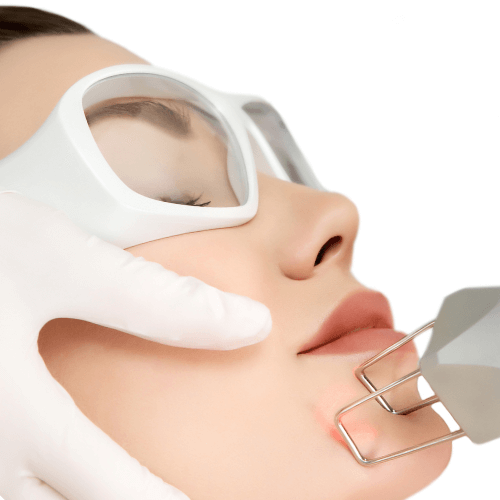
Parameters for the eye area: The settings used for CO2 eye treatment are specifically calibrated for the periorbital skin — lower energy and a different fractional density than those used for the full face, appropriate for the thinner, more delicate tissue of the eyelids and orbital rim. Treatment of the eye area requires protective eyewear for the patient throughout the procedure.
The clinical evidence for fractional ablative CO2 laser resurfacing in periorbital skin quality improvement is supported by peer-reviewed research. British Journal of Dermatology — CO2 laser and periorbital resurfacing
How Is CO2 Eye Treatment Performed? Step by Step
Before treatment:
- A mandatory consultation is required before any CO2 eye treatment can be booked — your skin type, periorbital concerns, suitability for treatment and the compulsory aftercare protocol are discussed in full at this appointment
- Retinoids and active skincare should be paused for seven days before treatment; no sun exposure to the eye area for four weeks prior
- Obtain your aftercare products before your treatment date — these are not included in the eye area pricing and are essential for safe healing
- Topical anaesthetic cream is applied to the periorbital area approximately one hour before the laser procedure to ensure comfort
During treatment:
- The periorbital skin is thoroughly cleansed and the anaesthetic cream removed
- Protective eye shields are placed over the eyes throughout the procedure
- The CO2 fractional laser handpiece is passed precisely over the periorbital treatment area — upper lid skin, lower lid, crow’s feet zone — delivering the calibrated fractional ablative energy at the agreed treatment parameters
- Treatment of the eye area typically takes 20 to 30 minutes once anaesthetic is in place; total appointment time including anaesthetic preparation is approximately 2 hours
After treatment:
- Significant swelling, redness and warmth in the periorbital area are expected and normal immediately after treatment — this is the acute wound-healing response
- The treated skin will crust and peel over days four to ten as re-epithelialisation occurs beneath the healing surface
- Strict adherence to the prescribed aftercare protocol is essential throughout healing — the products and routine your practitioner prescribes protect against infection, scarring and pigmentation complications
- Keep the treated area consistently moist using prescribed products; avoid any water exposure beyond gentle cleansing
- Sun exposure must be completely avoided for two months following treatment; daily broad-spectrum SPF is essential once the skin has healed
- Visible results become apparent from one to two weeks as healing completes; deeper collagen remodelling continues for three to twelve months post-treatment
3 Purposes of CO2 Eye Treatment
1. Restoring Periorbital Skin Quality Through the Most Powerful Non-Surgical Resurfacing Available
The primary purpose of CO2 eye treatment is to deliver the deepest and most comprehensive non-surgical resurfacing result available for the periorbital skin — producing a quality of collagen remodelling and skin renewal that no non-ablative approach can match. For patients with significant periorbital concerns whose skin quality, fine line depth or crepey texture has reached a point where less intensive treatments produce insufficient improvement, CO2 eye treatment provides a route to a genuinely transformative improvement in periorbital skin quality through a single course of treatment.
2. Maintaining Long-Lasting Periorbital Skin Quality Through Collagen Remodelling That Continues for Months
The collagen remodelling response triggered by CO2 eye treatment is not complete at the point of surface healing — it continues to develop and mature for three to twelve months following the final treatment session. The quality of the structural improvement in the periorbital dermis therefore increases progressively for months after the visible recovery has resolved, producing ongoing improvement in periorbital skin quality well beyond the initial post-treatment period. Results from a completed course of three sessions typically last twelve months or longer, with appropriate sun protection and skin maintenance.
3. Protecting Long-Term Confidence by Achieving a Transformative Periorbital Improvement That Cannot Be Replicated by Less Intensive Treatment
For patients who have tried a range of periorbital treatments and found them insufficient for the degree of change they want to see, CO2 eye treatment provides a genuinely different level of result. The depth of the collagen remodelling and skin renewal it produces represents a structural transformation of the periorbital tissue that has a lasting and meaningful impact on how the eye area looks — and consequently on how patients feel about their overall facial appearance. The commitment that CO2 eye treatment demands is real, but for patients with significant periorbital concerns the results justify it.
7 Proven Benefits of CO2 Eye Treatment
1. The most powerful periorbital resurfacing available without surgery CO2 fractional laser produces a depth and quality of collagen remodelling and skin renewal in the periorbital zone that no non-ablative treatment can match — appropriate for significant periorbital concerns where less intensive approaches have been insufficient.
2. Significant improvement in periorbital fine lines and crow’s feet The deep collagen remodelling response produces a meaningful reduction in the depth and prominence of periorbital fine lines, crow’s feet and the fine wrinkles of the upper and lower lid skin — a quality of improvement that develops and matures for months following the final treatment.
3. Improves crepey periorbital skin texture and skin quality The ablative resurfacing and subsequent collagen synthesis progressively improve the crepey, thin quality of periorbital skin — restoring a firmer, smoother and more structurally resilient skin appearance around the eyes.
4. Long-lasting results that continue to develop post-treatment The collagen remodelling response matures for three to twelve months following the final treatment, with ongoing improvement in periorbital skin quality throughout this period. Results from a completed course typically last twelve months or longer.
5. Fractional delivery supports faster healing than full-surface ablative treatment The fractional pattern leaves intact tissue between treated columns to support rapid re-epithelialisation — reducing recovery time compared to full-surface ablative CO2 while still achieving deep collagen remodelling results.
6. Combines with full face CO2 for comprehensive resurfacing CO2 eye treatment can be performed as a standalone periorbital treatment or combined with full face CO2 resurfacing in the same appointment, using appropriate parameters for each zone. Combination pricing is shown on the main CO2 laser face treatment page.
7. Safe for the periorbital zone with protective eyewear and appropriate parameters CO2 fractional laser eye treatment uses parameters specifically calibrated for the thin periorbital skin, and protective eye shields are used throughout the procedure to protect the eyes from any laser energy exposure.
What Can CO2 Eye Treatment Address?
Significant Periorbital Fine Lines and Deep Wrinkles
The deep collagen remodelling and surface renewal produced by CO2 fractional laser resurfacing significantly improves the appearance of pronounced periorbital fine lines, deep crow’s feet at the outer corners and the wrinkling of both upper and lower lid skin. This is the most direct and impactful indication for CO2 eye treatment — patients with significant periorbital wrinkling who want the most powerful non-surgical option available.
Crepey Upper and Lower Lid Skin
The ablative resurfacing and subsequent collagen synthesis produce a meaningful improvement in the crepey, thin and fragile quality of upper and lower eyelid skin — restoring a firmer, smoother and more resilient skin texture that reflects genuine structural improvement in the periorbital dermis.
Periorbital Skin Laxity
As new collagen and elastin are synthesised in the periorbital dermis following CO2 treatment, the skin around the eyes progressively tightens and firms — improving the lax quality of the periorbital skin that contributes to a hooded or drooping appearance around the eye area.
Periorbital Pigmentation and Uneven Skin Tone
The surface renewal triggered by CO2 ablative resurfacing removes the melanin-containing surface skin cells and encourages more even cellular turnover in the periorbital zone, progressively improving periorbital pigmentation and uneven skin tone as the skin heals and renews.
CO2 Eye vs LaseMD Eye — Choosing the Right Level of Treatment
Both CO2 eye and LaseMD eye use laser technology to improve periorbital skin quality, but they sit at very different points on the treatment intensity spectrum.
LaseMD eye is non-ablative — the skin surface remains intact throughout healing, producing one to three days of mild redness and dryness. It is the appropriate choice for patients who want meaningful improvement with minimal downtime and suits patients at an earlier stage of periorbital ageing or those who need to return to normal activities quickly.
CO2 eye is ablative — the skin surface is resurfaced, producing seven to ten days of visible healing. It is the appropriate choice for patients with more significant periorbital concerns — deeper lines, more pronounced crepey texture, greater skin quality deterioration — where LaseMD does not produce sufficient depth of improvement.
The decision between them is primarily about the degree of concern versus the downtime that can be accommodated. Your practitioner will discuss which is most appropriate for your periorbital skin and circumstances at consultation.
CO2 Eye vs Polynucleotide Eye and SuneKOS Eye — Different Approaches
Polynucleotide eye treatment and SuneKOS eye treatment are injectable biostimulation treatments that improve periorbital skin quality through collagen stimulation from below the surface — with minimal downtime and results that develop progressively over weeks.
CO2 eye treatment resurfaces the skin surface through ablative laser energy — working from the surface inward with a more immediate and dramatic remodelling effect but significantly more downtime.
The two approaches address the periorbital skin from different directions and at different levels of intensity. For patients with milder concerns or who want the injectable biostimulation route, polynucleotides or SuneKOS are more appropriate. For patients with significant periorbital concerns where a more powerful resurfacing result is needed, CO2 eye delivers that result. Some patients use injectable biostimulation as a maintenance programme between CO2 treatment cycles.
Why Choose Elements Medical for CO2 Eye Treatment in Doncaster?
CO2 fractional laser treatment in the periorbital zone requires a higher level of clinical precision and experience than almost any other aesthetic procedure — thin skin, proximity to the eye, and the significant downtime and aftercare demands all make the quality of the consultation, the calibration of treatment parameters and the aftercare guidance critical to achieving a safe and excellent outcome.
At Elements Medical, CO2 eye treatment is performed only following a thorough mandatory consultation in which your skin type, concerns, suitability and the full aftercare protocol are discussed in detail. We do not book CO2 eye treatment without this consultation, and we ensure every patient begins treatment with accurate expectations of both the result and the recovery.
CO2 eye treatment is part of our comprehensive eye treatment range alongside LaseMD eye, polynucleotide eye and SuneKOS eye treatments. For full face CO2 resurfacing, see our CO2 laser skin resurfacing page.
Read what our patients say on our Google Reviews page





 What is CO2 eye treatment and what does it do?


Call us: 01302 34 34 32
Email us: reception@elements.org.uk
Visit our Instagram
Visit our Facebook
Visit our TikTok
Contact us on WhatsApp