PRF Hair Treatment in Doncaster
Hair thinning and hair loss affect a significant proportion of both men and women and can have a genuinely significant impact on confidence and sense of self — often more so than many visible skin concerns. The underlying causes are varied but the biological consequence is broadly consistent: hair follicles that were once active become miniaturised, enter a prolonged resting phase and eventually cease to produce visible hair. The most effective non-surgical interventions are those that address this follicular biology directly, which is precisely what PRF treatment does.
PRF works by delivering the body’s own growth factors — derived from your own blood and concentrated by centrifugation — directly into the scalp tissue surrounding the hair follicles. These growth factors stimulate follicular cells, improve the blood supply to the follicular environment, prolong the active hair growth phase (anagen) and reactivate follicles that have entered a dormant state. The fibrin matrix that forms within the PRF preparation traps these growth factors at the injection site and releases them slowly over several weeks, extending the regenerative stimulus of each session significantly beyond the appointment itself.
At Elements Medical we offer PRF hair treatment as a standalone course for patients with hair thinning and early to moderate hair loss, and as a complementary support course for patients who have undergone a hair transplant and want to optimise follicular recovery and long-term density.
Our Doncaster clinic is on Thorne Road with on-site parking, and we welcome patients from across South Yorkshire including Rotherham, Wakefield, Sheffield, Leeds and Barnsley.
What Causes Hair Thinning and Hair Loss?
Understanding why hair loss occurs helps to explain why PRF treatment is effective in addressing it.
Hair grows in cycles: an active growth phase (anagen), a transitional phase (catagen) and a resting phase (telogen), followed by shedding and regrowth. In healthy hair, the majority of follicles are in the active anagen phase at any given time. Hair thinning occurs when this balance shifts — when more follicles enter the resting or dormant phase, when the anagen phase shortens, or when the follicles themselves become structurally compromised.
The most common causes include:
Androgenetic alopecia (pattern hair loss) The most prevalent cause of hair loss in both men and women, driven by the conversion of testosterone to dihydrotestosterone (DHT) in the scalp. DHT binds to receptors in genetically susceptible follicles, progressively miniaturising them over time. In men this typically presents as a receding hairline and crown thinning; in women it more commonly presents as diffuse thinning across the crown and parting.
Hormonal changes In women, hormonal fluctuations associated with the menopause, postpartum recovery or thyroid dysfunction can significantly disrupt the hair growth cycle, leading to increased shedding and reduced density. Oestrogen normally prolongs the anagen phase; as oestrogen levels decline, the balance shifts towards earlier follicular entry into the resting phase.
Nutritional deficiencies Deficiencies in iron, ferritin, vitamin D, zinc and B vitamins are among the most common addressable contributors to hair loss, particularly in women.
Stress and telogen effluvium Significant physical or psychological stress can trigger a large proportion of follicles to enter the resting phase simultaneously, resulting in a period of diffuse, often dramatic shedding approximately three months after the triggering event. This typically resolves with time, though PRF can support the recovery process.
Alopecia areata An autoimmune condition in which the immune system attacks hair follicles, producing patchy or more extensive hair loss. Suitability for PRF treatment in this context is assessed at consultation.
PRF treatment is most effective for androgenetic alopecia, hormonally related hair thinning and telogen effluvium — particularly when follicles are miniaturised but still present and capable of responding to growth factor stimulation. Suitability is always assessed at consultation.
How Does PRF Work on the Scalp?
The growth factors concentrated in PRF act on the scalp and hair follicles through several overlapping mechanisms:
PDGF (platelet-derived growth factor) stimulates the proliferation of dermal papilla cells — the cells at the base of each follicle that regulate its growth cycle — and promotes the transition from resting phase back into active growth.
VEGF (vascular endothelial growth factor) promotes the formation of new blood vessels (angiogenesis) around the follicular unit, improving the delivery of oxygen and nutrients to follicular cells and creating a more supportive follicular environment.
TGF-β (transforming growth factor) plays a key role in regulating the hair growth cycle, supporting the extension of the anagen (growth) phase and slowing follicular entry into the resting phase.
EGF (epidermal growth factor) supports cell proliferation and the overall health of the follicular epithelium.
IGF-1 (insulin-like growth factor) stimulates dermal papilla cells and has been shown in research to promote hair shaft elongation and follicular survival.
The fibrin matrix formed in the PRF preparation is equally important. By trapping these growth factors at the injection sites within the scalp, it creates a sustained-release depot that continues to deliver biological signals to the follicular environment over several weeks — meaning each treatment session has a regenerative effect that extends well beyond the appointment itself.
The role of platelet-derived growth factors in supporting hair follicle biology and scalp regeneration is supported by a growing body of peer-reviewed research. British Journal of Dermatology — platelet growth factors and hair
How Is PRF Hair Treatment Performed? Step by Step
At each appointment:
- A small blood sample is drawn — typically around 10 to 20ml — using standard venepuncture
- The sample is centrifuged to separate the concentrated PRF layer from the red blood cells beneath it
- The PRF preparation is drawn up into syringes ready for scalp injection
- The scalp is cleansed and the treatment area mapped according to the pattern and distribution of hair thinning
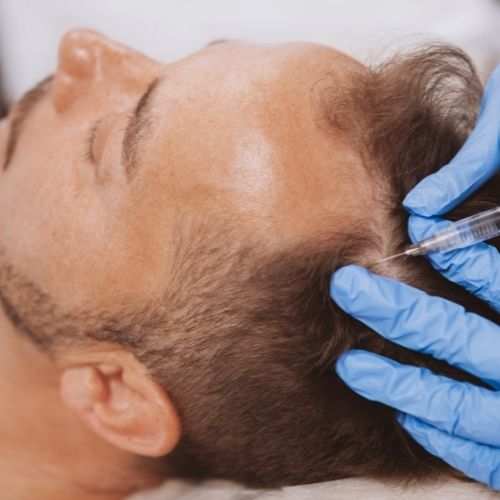
- PRF is injected directly into the scalp using a fine needle across all areas of concern, delivering growth factors at follicular depth throughout the treatment area
- The full appointment takes approximately 45 to 60 minutes
After each session:
- The fibrin matrix begins forming at the injection sites, trapping growth factors in the scalp tissue
- Growth factors are released gradually over several weeks, activating follicular cells and extending the hair growth phase
- Mild swelling, redness and tenderness at injection sites are normal and typically subside within 48 hours
- Improvement in hair shedding and early regrowth is often noticeable from approximately four weeks after the first session, with density continuing to improve across the course
- A course of six sessions at three to four week intervals is recommended for best results
3 Purposes of PRF Hair Treatment
Every PRF hair treatment course at Elements Medical serves three clear therapeutic purposes.
1. Restoring Hair Follicle Activity Through Targeted Growth Factor Delivery
PRF hair treatment addresses hair loss at its biological root — delivering the growth factors that follicular cells need to resume and sustain active hair production directly to the follicular environment. Rather than masking or accommodating hair loss, PRF works to genuinely restore the biological conditions in which hair follicles thrive: improved blood supply, activated dermal papilla cells, extended growth cycles and reduced follicular miniaturisation. For patients with living but dormant follicles, this biological restoration can produce a meaningful and lasting improvement in hair density.
2. Maintaining Improved Hair Density Through Ongoing Follicular Support
Hair loss is, in most cases, a progressive condition — the biological pressures that caused follicles to miniaturise continue to act unless actively managed. A maintenance programme of PRF sessions after the initial course sustains the elevated growth factor environment in the scalp and continues to support follicular health over time. This maintenance dimension is particularly important for androgenetic hair loss, where ongoing follicular support is needed to preserve the gains achieved through treatment.
3. Protecting Confidence and Psychological Wellbeing
Hair loss is consistently ranked among the aesthetic concerns with the greatest impact on confidence, self-perception and psychological wellbeing — across both men and women, and across a wide age range. The improvement in hair density and the visible reduction in shedding that PRF treatment produces can have a deeply meaningful effect on how patients feel about their appearance and about themselves. At Elements Medical we take this dimension of the treatment seriously, and support patients through a realistic, honest treatment plan that manages expectations alongside delivering genuine results.
7 Proven Benefits of PRF Hair Treatment
1. Entirely autologous — uses only your own biology PRF is derived from your own blood. There is no foreign product, no synthetic substance and no risk of allergic reaction or rejection of any kind.
2. The fibrin matrix provides sustained slow-release growth factor delivery Unlike conventional PRP, where growth factors dissipate within hours, PRF’s fibrin scaffold traps growth factors at the injection sites and releases them gradually over several weeks — extending the regenerative effect of each session.
3. Directly reactivates dormant hair follicles Growth factors including PDGF, IGF-1 and TGF-β act directly on dermal papilla cells to stimulate follicular re-entry into the active growth phase, addressing hair loss at its biological origin.
4. Improves scalp vascularisation and follicular nutrition VEGF-driven angiogenesis improves blood vessel formation around follicular units, enhancing the delivery of oxygen and nutrients to follicles — creating a significantly more supportive environment for sustained hair growth.
5. Reduces shedding and extends the active hair growth phase By prolonging the anagen phase and supporting follicular health, PRF treatment helps to reduce the excessive shedding that characterises active hair loss and restores a more normal hair growth cycle.
6. Suitable for both men and women PRF hair treatment is effective for androgenetic alopecia in both men and women, for hormonally related hair thinning, and for telogen effluvium. Suitability is assessed at consultation.
7. Complementary to hair transplant surgery A course of PRF scalp treatment following a hair transplant supports graft survival, accelerates follicular recovery and helps to maximise transplant density outcomes. A shorter course of three sessions is recommended in this context.
Who Is PRF Hair Treatment Suitable For?
Men with Androgenetic Alopecia (Male Pattern Hair Loss)
Male pattern hair loss is the most common form of hair loss and is driven by DHT sensitivity in genetically predisposed follicles. PRF treatment is most effective when follicles are miniaturised but still present and capable of responding to growth factor stimulation — typically in the earlier and middle stages of hair loss. PRF can be used alongside other hair loss management strategies including topical treatments.
Women with Diffuse Hair Thinning
Female hair loss, whether driven by androgenetic alopecia, hormonal change or nutritional factors, typically presents as diffuse thinning across the crown and parting rather than the defined recession pattern seen in men. PRF is well suited to this pattern, treating the affected area comprehensively across multiple injection points per session.
Patients Experiencing Post-Menopausal Hair Thinning
The decline in oestrogen during and after the menopause disrupts the hair growth cycle, shifting more follicles into the resting phase and reducing hair density over time. PRF treatment supports follicular recovery by delivering growth factors that compensate in part for the reduced hormonal support of follicular function.
Patients Recovering from Telogen Effluvium
A period of significant physical or psychological stress can trigger widespread shedding (telogen effluvium) approximately three months after the event. PRF treatment supports the recovery of the hair growth cycle by stimulating follicular re-entry into the active phase and accelerating the restoration of normal density.
Post-Hair Transplant Patients
PRF scalp treatment following a hair transplant procedure supports graft survival during the vulnerable early recovery period, promotes healing of the recipient area and helps to ensure the maximum proportion of transplanted follicles produce hair. A course of three sessions is recommended, timed in consultation with the treating surgeon.
PRF Hair Treatment vs Exosome Scalp Treatment
Both PRF and exosome scalp treatment use growth factor delivery to stimulate hair follicle activity, and patients considering either treatment often ask how they compare.
PRF is entirely autologous — the growth factors are derived from the patient’s own blood, with no external product introduced. The growth factor concentration and profile reflects the individual’s own biology. PRF is injected directly into the scalp at follicular depth, ensuring precise placement.
Exosome scalp treatment uses a standardised formulation containing concentrated exosomes and a defined payload of growth factors, peptides, vitamins and hyaluronic acid, derived from bovine colostrum. Because the formulation is fixed and consistent, the growth factor profile and concentration are predictable and high. Exosomes are delivered via microneedling rather than injection.
For patients who prefer a fully autologous approach or who want targeted injection into specific areas of the scalp, PRF is an excellent choice. For patients who want a standardised, high-concentration growth factor delivery that is independent of their own blood composition, exosome scalp treatment offers a consistent alternative. Both treatments can also be used together as part of a combined scalp regeneration programme. Your practitioner will advise on the most appropriate approach at consultation.
PRF Hair Treatment vs Polynucleotide Scalp Treatment
Polynucleotide treatment is also used for hair restoration, delivered by scalp injection to stimulate follicular activity through receptor-mediated DNA repair pathways. It works through a different mechanism to PRF — binding to the A2A adenosine receptor to activate specific repair and regeneration signals — and has a well-established evidence base for scalp applications.
Both treatments produce meaningful improvements in hair density and follicular health. They can be used together as part of a comprehensive hair restoration programme, providing complementary biological stimulation through different mechanisms simultaneously.
Why Choose Elements Medical for PRF Hair Treatment in Doncaster?
Hair restoration is an area where patient expectations need to be carefully managed alongside delivering genuine clinical results. At Elements Medical we are committed to honest assessment of suitability and realistic discussion of what PRF treatment can and cannot achieve, and we tailor the treatment programme — including course length, session spacing and any complementary treatments — to each individual patient’s pattern and stage of hair loss.
We offer PRF hair treatment alongside exosome scalp treatment and polynucleotide treatment, and will always recommend the approach — or combination — that is genuinely most suited to your concern and your goals.
Read what our patients say on our Google Reviews page.




 What is PRF hair treatment?


Call us: 01302 34 34 32
Email us: reception@elements.org.uk
Visit our Instagram
Visit our Facebook
Visit our TikTok
Contact us on WhatsApp